IP Surveillance: The Future of Security Monitoring

In a world increasingly driven by digital technology, IP surveillance systems have revolutionized how we protect homes, businesses, and public spaces. By merging traditional video monitoring with the power of the internet, IP (Internet Protocol) surveillance delivers smarter, more flexible, and more secure ways to observe and record events in real time.
What Is IP Surveillance?
IP surveillance refers to a security system that uses Internet Protocol (IP) cameras to capture and transmit video data over a network—typically the internet or a local area network (LAN). Unlike older analog CCTV systems that required dedicated coaxial cabling, IP cameras use standard network cables (Ethernet) and can integrate easily with existing IT infrastructure.
In simpler terms, an IP surveillance system is a network-based video monitoring solution that allows users to view, record, and manage footage remotely, often through mobile devices or web applications.
How IP Surveillance Works
An IP surveillance system typically includes:
- IP Cameras – Capture high-definition video and convert it into digital data.
- Network Switches and Routers – Connect cameras to the network and enable communication with other devices.
- Network Video Recorder (NVR) – Stores video footage and allows playback and management.
- Viewing Devices – PCs, smartphones, or tablets used to monitor live or recorded footage.
Video data is transmitted as packets through the network using standard communication protocols like TCP/IP, HTTP, and RTSP (Real-Time Streaming Protocol). Depending on configuration, the data can be stored locally, on a network server, or in the cloud.
Advantages of IP Surveillance
1. High-Definition Video Quality
IP cameras offer resolutions ranging from 1080p to 4K and beyond, capturing sharper details for better facial recognition and object identification.
2. Remote Accessibility
One of the biggest advantages is the ability to view live or recorded footage from anywhere via the internet. This is ideal for business owners or homeowners who want to monitor properties remotely.
3. Scalability
Unlike traditional CCTV systems that require major rewiring to add cameras, IP networks are highly scalable. New cameras can easily be added to an existing network infrastructure.
4. Advanced Analytics
Modern IP cameras come equipped with AI and video analytics features—such as motion detection, facial recognition, license plate reading, and intrusion alerts—reducing the need for constant manual monitoring.
5. Cost-Effective Over Time
Although initial setup costs may be higher, IP surveillance systems save money through simplified installation, remote management, and reduced maintenance needs.
IP Surveillance vs. Analog CCTV
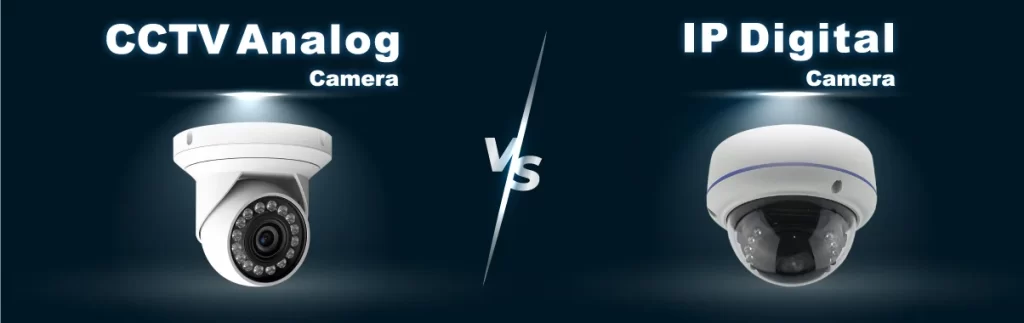
| Feature | IP Surveillance | Analog CCTV |
|---|---|---|
| Image Quality | Up to 4K or higher | Limited (typically <1MP) |
| Connectivity | Uses network cables | Uses coaxial cables |
| Remote Access | Available via web/app | Requires DVR connection |
| Scalability | Easily expandable | Limited |
| Intelligence | Supports AI and analytics | Minimal automation |
Security Considerations
While IP surveillance offers great benefits, it also introduces cybersecurity risks since cameras are connected to the internet. Protecting these systems requires:
- Strong passwords and encryption
- Firmware updates to patch vulnerabilities
- Network segmentation to isolate cameras from other systems
- Secure cloud storage for video backups
A well-designed security plan ensures that IP cameras remain an asset, not a liability.
The Future of IP Surveillance
The evolution of IP surveillance continues to accelerate, driven by advancements in artificial intelligence (AI), machine learning, and cloud computing.
Future trends include:
- Edge computing, where cameras process data locally for faster alerts.
- 5G integration for high-speed wireless video transmission.
- Smart city applications that use interconnected surveillance systems for public safety and traffic management.
These innovations make IP surveillance not just a tool for protection—but a cornerstone of smart, data-driven security ecosystems.
Conclusion
IP surveillance represents a major leap forward in the field of security. By combining high-quality imaging, intelligent analytics, and remote accessibility, it offers both efficiency and peace of mind. Whether deployed in homes, offices, or entire cities, IP-based systems are setting the new standard for safety in the digital age.