VoIP Service: Transforming the Way We Communicate

In an era where digital transformation shapes how we work and connect, Voice over Internet Protocol (VoIP) has become one of the most significant innovations in modern communication. From businesses seeking cost-efficient collaboration to individuals making long-distance calls at little to no cost, VoIP technology has revolutionized voice communication worldwide.
What Is VoIP?
Voice over Internet Protocol (VoIP) is a technology that allows users to make voice calls using the internet instead of traditional telephone lines. In essence, VoIP converts analog voice signals into digital data packets that travel through IP networks—whether that’s a local area network (LAN), wide area network (WAN), or the internet.
VoIP eliminates the need for conventional phone lines, making communication more flexible, scalable, and cost-effective.
How VoIP Works
VoIP technology uses a combination of hardware and software to facilitate digital voice communication. Here’s a simplified breakdown of the process:
- Voice Capture – When a person speaks into a VoIP phone or microphone, the analog voice signal is captured.
- Signal Conversion – The signal is converted into digital data packets using codecs (coder-decoders).
- Data Transmission – These packets are sent over an IP network to the recipient’s device.
- Reassembly & Playback – The receiving system reassembles the packets and converts them back into audio.
All of this happens in real time, ensuring clear, instant communication.
Key Components of a VoIP System
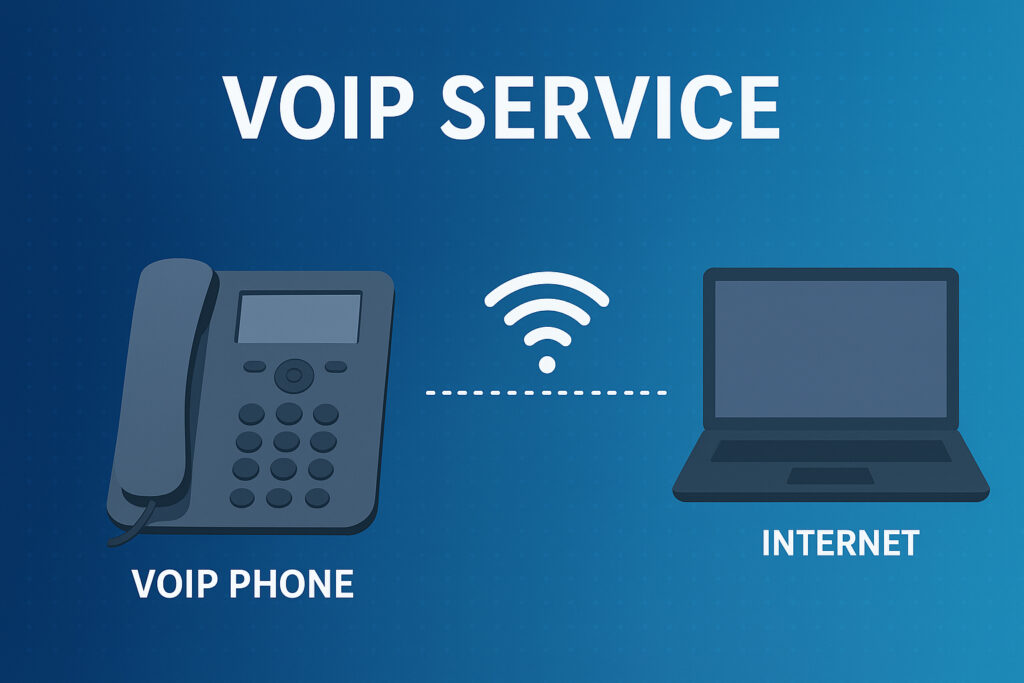
- IP Phones or Softphones – Specialized phones designed for VoIP, or software applications that enable calls via computers or smartphones.
- VoIP Gateway – Connects traditional phone systems (PSTN) to VoIP networks.
- PBX (Private Branch Exchange) – A private phone network used within an organization to manage calls.
- Internet Connection – A stable broadband connection is essential for clear, uninterrupted communication.
- VoIP Service Provider – Delivers the network infrastructure and services required to make VoIP calls possible.
Benefits of VoIP Services
1. Cost Savings
VoIP significantly reduces communication costs—especially for international and long-distance calls—since it uses existing internet connections rather than dedicated phone lines.
2. Flexibility and Mobility
With VoIP, users can make and receive calls anywhere with internet access. This flexibility supports remote work and global business operations.
3. Feature-Rich Communication
VoIP systems include advanced features like:
- Call forwarding and voicemail
- Video conferencing
- Auto attendants and call queues
- Instant messaging and presence indicators
- Integration with CRM and collaboration tools
4. Scalability
Adding new users or locations is easy with VoIP—no need for additional wiring or hardware installations.
5. Unified Communication
VoIP integrates with email, chat, and video tools, creating a unified communications platform that streamlines collaboration.
Types of VoIP Services
- Hosted VoIP (Cloud-Based) – The VoIP service provider manages all hardware and servers, while users simply connect via the internet.
- On-Premises VoIP – Businesses host their own VoIP servers internally for more control and customization.
- Residential VoIP – Offers affordable home calling plans, often bundled with internet services.
- Mobile VoIP – Apps like Skype, WhatsApp, and Zoom enable VoIP calls directly through smartphones.
Challenges and Considerations
Despite its benefits, VoIP is not without challenges:
- Internet Dependence – Poor connectivity can cause lag, dropped calls, or jitter.
- Power Outages – Unlike traditional phones, VoIP devices require power and internet access.
- Security Risks – As VoIP uses the internet, it can be vulnerable to hacking or eavesdropping if not properly secured.
Solutions:
Implementing encryption, firewalls, and Quality of Service (QoS) settings can help ensure call clarity and protect sensitive data.
The Future of VoIP
As technology advances, VoIP continues to evolve alongside AI, 5G, and cloud computing. Future trends include:
- AI-driven call analytics for improving customer service.
- Voice assistants integrated into VoIP platforms.
- 5G-powered VoIP enabling ultra-low latency and HD voice/video.
- Integration with IoT devices, allowing voice interaction across smart environments.
VoIP is no longer just a business communication tool—it’s the foundation of modern digital communication ecosystems.
Conclusion
VoIP services have transformed communication by combining affordability, flexibility, and advanced functionality. Whether you’re a small business owner, a large enterprise, or a home user, VoIP offers a scalable and efficient solution that adapts to your communication needs.
As internet technology grows faster and more reliable, the future of voice communication lies firmly in the realm of VoIP—connecting people seamlessly, anywhere in the world.